
Advantage+ Sales Campaigns (ASC) vs manual: you are probably structuring this wrong

Advantage+ Sales Campaigns (formerly Advantage+ Shopping Campaigns) is the most automated sales campaign Meta has built for e-commerce yet. It dramatically simplifies campaign management. Instead of manually building out audience segments, testing placements, and splitting budgets across ad sets, advertisers simply supply the creative, whether a product catalogue or video, and Meta’s ranking system will handle audiences, placements, and budget allocation for the campaign, hunting for buyers at scale.
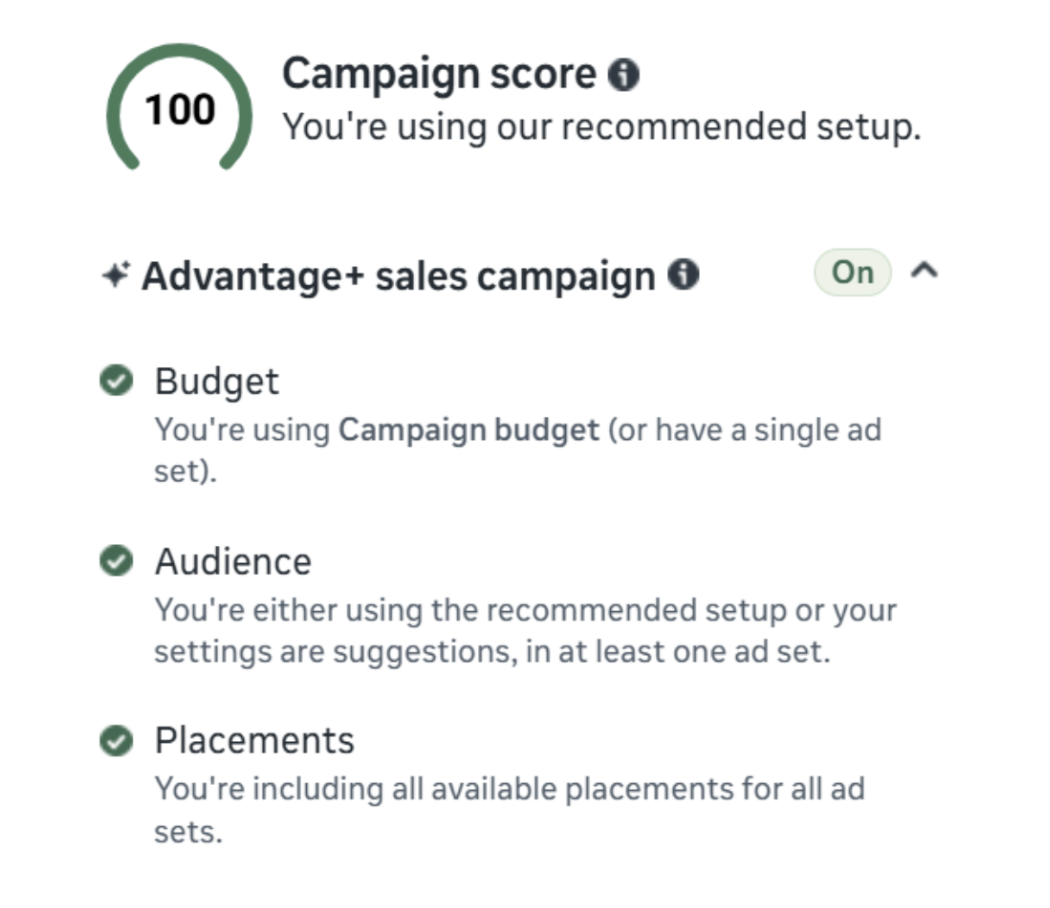
The more ASC can do, the harder it is to give it the right strategic role. This conundrum is heightened by Meta merging the manual and Advantage+ campaign creation flows into a single interface. “Manual” no longer means a separate campaign type, but a set of controls you can deliberately reclaim.
We have seen many advertisers misuse ASC by putting it in the wrong place in their strategy and asking it to do jobs it was never built for. In this case, performance becomes unreadable. ROAS rises and falls, but nothing in the account tells you why, or what to change.
Misuse 1: running ASC as your only campaign
ASC's automation makes it look like the only campaign you need, but running it as your cure-all leaves two structural gaps.
The first is visibility. ASC reaches broadly and spends efficiently, but the algorithm reveals little about which audience segment is converting. A manually controlled interest campaign isolates a specific segment, shows how it responds, and generates audience and creative learnings that inform the next move.
The second is control. ASC treats audience inputs as signals1, so precise custom-audience plays, such as cart abandoners, site viewers and customer-list lookalikes are not available inside the structure. Manually controlled campaigns still give exclusions and custom audiences at the ad set level.
So if you were to run ASC alone, three main issues pop up:
- There is no campaign isolating segments and testing creative, so you cannot get a clean read on resonance.
- There is no dedicated campaign for warm audiences, so they get absorbed into ASC’s broad signal instead of being targeted deliberately.
- There is nothing for ASC to learn from: no evidence for what to feed into ASC, what to cut, or what to scale.
The right approach is a portfolio where ASC and manually controlled campaigns run together with defined roles, rather than one replacing the other:
Misuse 2: Letting ASC and manual compete on ROAS
The second misuse is subtler: Brands run both ASC and manual, but notice one has a higher ROAS than the other and proceed to cut the weaker-looking one. The logic is flawed because ASC and manually controlled campaigns do not measure the same thing.
ASC blends prospecting and retargeting into one campaign and reports a single ROAS. Even with exclusion settings in place, ASC can still reach audiences your other campaigns are already converting. When both touch the same user before a conversion, both claim credit and campaign-level ROAS is distorted.
The right measure is not campaign-level ROAS but overall ROAS: total purchase revenue against total spend in the account. Pull it weekly on a fixed day, so the trend stays comparable.
To manage the overlap, keep remarketing audiences well defined in the account-level setup so ASC knows who to treat as an existing customer. Remarketing and interest campaigns can then be kept under manual with defined roles. Some overlap between ASC and manual campaign types is unavoidable, but with defined roles, the internal competition stays controlled.
When ASC isn't the right fit
Each ad set needs roughly 50 purchase conversions a week to exit the learning phase and deliver stably2. The threshold is Meta's standard guidance for stable delivery. Below that volume, the algorithm lacks the signal to optimise on. Accounts without the weekly volume should run manual conversion campaigns first to build pixel signal and test creative. ASC is where you go once there is something worth scaling.
The bottom line
Run ASC alone and it has no proven creative to scale; run it against manual in a ROAS competition, you will cut the campaigns doing the work ASC is taking credit for. The question was never whether to use ASC, it is whether it has a defined job, and whether your measurement can tell you if it is doing it.
References
1. Meta for Business, "Advantage+ Shopping Campaigns: Automated Shopping Ads.
2. Adlibrary, "Meta Ads Learning Phase: 50 Events Per Week Explained.
Need support with an account restructure?
Talk to our team at Meetsocial to find out how we can help.


Google Ads has long been written off as “slow” for product testing, but the 2026 evolution of Demand Gen changes that.

Google's biggest Search ads upgrade in a decade swaps keyword lists for intent signals, rewrites ad copy on the fly, and reroutes clicks to the best landing page. Here's how it works and how to launch it for your brand.

From misaligned conversion events to hidden delivery fees, the reasons your carts are not converting are often simpler, and cheaper to fix than you think.